Building Enterprise SaaS from Concept to Production
What actually separates a working demo from a SaaS product a business can run its finances on.
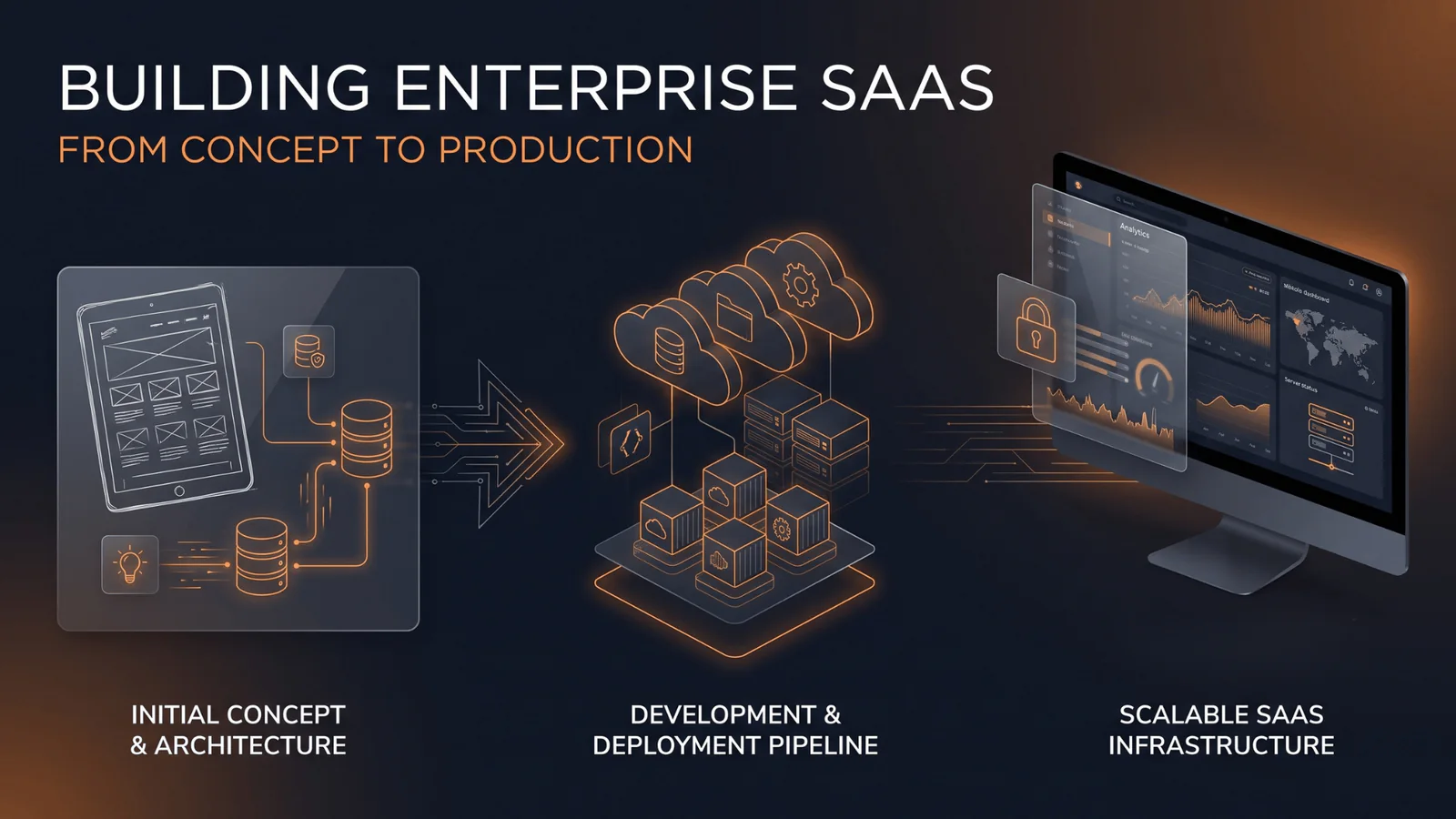
The distance between a SaaS demo and a SaaS product a business actually depends on is almost entirely invisible in a screenshot — and almost entirely the work.
The data model comes first, not the UI
Every enterprise SaaS project starts with the same temptation: design the screens first, because that's what stakeholders can react to. The more durable order is the opposite. The data model — how companies, users, permissions and records relate to each other — is the piece that's genuinely expensive to change once real data exists.
Multi-tenancy is a decision, not a detail
Whether a platform serves one company or many changes the database schema, the authentication flow and the billing model from day one. Retrofitting multi-tenancy after a single-tenant build is one of the more expensive migrations in software — far more expensive than the extra planning it takes to decide correctly at the start.
- Model the core entities (company, user, record) before designing a single screen.
- Decide row-level security and access boundaries early — they touch every query later.
- Treat billing and plan logic as core infrastructure, not a feature to bolt on later.
The concurrency test
Before shipping any financial or transactional workflow, ask what happens if two users perform the same action at the same instant. If the honest answer is "I'm not sure," that's the next thing to fix, not launch.
Production is a different bar than working
A feature that works in a demo and a feature that survives production are different claims. Production means it handles a payment that fails halfway, a form submitted twice, a report requested with no data yet. None of that shows up in a pitch, and all of it determines whether a business can actually run on the software.
The takeaway
Enterprise SaaS is won in the parts nobody photographs — the data model, the tenancy boundaries, the behavior under concurrent and partial failure. Getting the visible 20% right is necessary but not sufficient; the other 80% is what makes it enterprise-grade.
Does this topic connect with a product or challenge in your team?
Let’s discuss your product needs, architecture or workflows.